Testing Your App Idea: How Good Is My App Idea?
Almost every app idea meets with approval: from friends, from colleagues and, these days, from chatbots too. None of that counts in the market, where willingness to pay decides. This article shows how to validate your app idea in a few weeks with a structured smoke test, which signals actually hold up, and what that costs compared with development.
 Thomas Henz

Testing an app idea means checking the riskiest assumption in the business model against real user behaviour before any development budget is committed. The most effective tool for this is a smoke test: a landing page with visible prices, paid traffic and thresholds defined in advance. Within a few weeks, this test delivers a robust go-or-no-go decision.
A typical first meeting at Johnny Bytes goes like this: a founder arrives with a 30-page concept document, say for a subscription app for lending tools between neighbours (we are using a purely fictional example here). ChatGPT has rated the idea as promising, friends are enthusiastic, and an acquaintance would “invest immediately”. Asked how many people have demonstrably shown they are willing to pay for it every month, there is no answer. That is exactly where validation begins.
Why do apps fail in the market rather than on the technology?
When apps fail, it is overwhelmingly because too few people need them. Only in the rarest of cases is the technical implementation to blame. In March 2026, CB Insights analysed the public post-mortems of 431 VC-funded startups that had failed since 2023: 43 percent named a lack of product-market fit as the cause. Although 70 percent ended with “ran out of cash”, CB Insights explicitly classifies that as the final stop, not the root of the problem.
What is product-market fit?
Product-market fit describes the state in which a product solves a real problem for a clearly defined target group so well that they use it voluntarily, repeatedly and, when it comes down to it, for money. Without that fit, neither clean code nor a bigger marketing budget will help.
Everyday usage confirms the pattern after launch: according to AppsFlyer’s App Uninstall Report (2025, Android data for 2024), 46.1 percent of installed apps are uninstalled again within 30 days. In its Mobile App Trends 2026 report, Adjust measures a median day-30 retention of around 7 percent across all industries. So the market tests every app anyway, and it does so mercilessly. The only choice you have is whether that test takes place before or after the development investment.
How do you test an app idea?
Testing an app idea requires a systematic check of the critical assumptions behind it against real user behaviour rather than opinions, before budget is tied up. The yardstick is falsifiable: before the test, you write down which result confirms the idea and which one refutes it.
The most important lever here is the RAT principle (Riskiest Assumption Test): the first thing you test is the one assumption whose failure would topple the entire business model. For the fictional tool-lending app, the riskiest assumption is not “do people like the idea”. Almost any social circle answers that with yes, because approval costs nothing. The risky assumption is “will neighbours pay a recurring monthly fee for access to other people’s power drills, and at what price”. Behind that, in descending order, come questions of trust and the question of how much a customer actually costs to win through advertising (one part of the customer acquisition cost calculation).
This gives good test hypotheses their shape: concrete, measurable, with a threshold and a kill criterion. Two examples: “At least 8 percent of paid visitors click on a specific pricing plan” and “at least 3 percent leave their email address after seeing the price”. If the figures fall short, the idea is adjusted or buried, not talked up. This discipline protects you from the most expensive pattern in product development: the sunk cost fallacy.
Which signals provide real evidence?
The closer a user action gets to an actual payment, the more robust it is as evidence. An email address on a waiting list is the weakest usable signal. Considerably stronger is a click on a specific pricing plan, then a click on “Book now” with the fake door notice waiting behind it, then a started checkout, and at the very top a real deposit or pre-order.
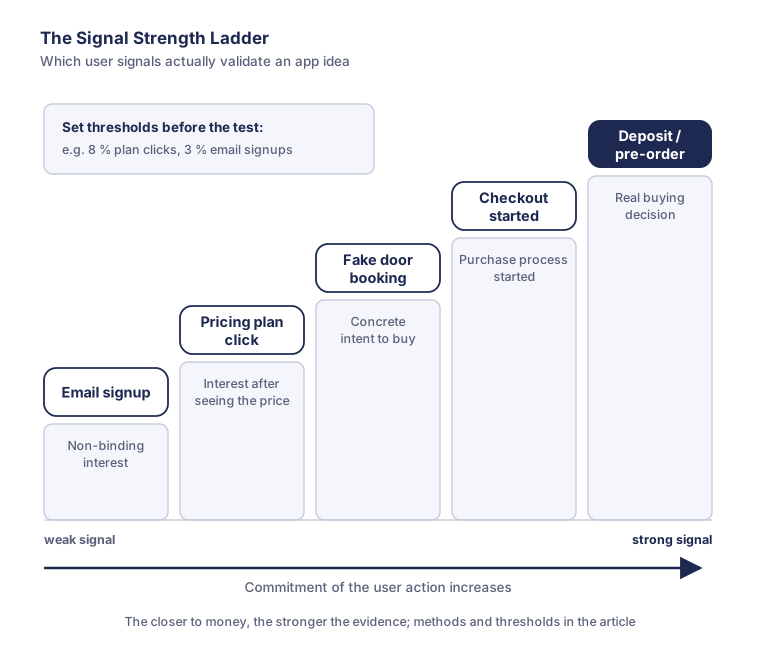
Two terms, cleanly defined: a smoke test is a demand experiment in which an offer is advertised as if it were already available, in order to measure real purchase signals before the product exists. A fake door test is the most common implementation of it: instead of leading to a checkout, the buy button leads to an honest message (“We are launching soon”) with the option to sign up.
The methods at a glance:
| Method | Primarily tests | Signal strength | Duration |
|---|---|---|---|
| User interviews | Problem and current behaviour | Medium (qualitative) | 1 to 2 weeks |
| Survey or waiting list | Non-binding interest | Weak | A few days |
| Clickable prototype test | Comprehensibility and interaction logic | Medium | 2 to 3 weeks |
| Smoke test with prices | Willingness to pay and customer acquisition cost | Strong | 4 to 8 weeks |
| Pre-order with payment | Actual purchase decision | Very strong | 4 to 12 weeks |
What matters is the combination: interviews explain the why, the smoke test measures the how many. A landing page without prices, by contrast, measures only curiosity, and surveys alone systematically overestimate demand because agreeing costs nothing.
How does a professional smoke test work?
A robust smoke test follows five steps: fix the hypotheses, build a landing page with prices, run paid traffic, measure the funnel and follow up qualitatively. The order is decisive, because anyone who sets the thresholds only after the test will read into the numbers whatever they want to see.
The landing page shows the value proposition, a short explanation of the features and a pricing table with two or three plans. The call to action for each plan leads into the fake door flow with an honest message, an email field and, optionally, three short questions about current behaviour. This way you measure conversion after the price confrontation and at the same time gain qualitative data from exactly the right people.
For traffic, the rule is: paid and segmented rather than organic. A post in your own network reaches the wrong audience and yields no repeatable customer acquisition cost (CAC: the advertising cost incurred for each lead or customer won). As a guideline from our project practice: a few hundred euros of media budget on Meta or Google, precisely targeted at the audience, with at least 500 to 1,000 visitors per variant so that the signal stays larger than the noise. As a by-product, you get your first real CAC data point: cost per signup.
Measurement is done as a funnel: visitors, price seen, plan clicked, email left, questions answered. Privacy-friendly tools such as Matomo or Plausible map this cleanly even without cookies. Once the test ends, five to ten short interviews with those who signed up follow, because the smoke test tells you how many want it, but not why. Only the two together will support a decision.
In practice: your validation roadmap for a few weeks
A validation sprint can be carried out cleanly in a few weeks if the order is right:
- Weeks 1-2, foundation: Name the riskiest assumption and write down the hypotheses with thresholds and a kill criterion. Build the landing page with pricing table and fake door flow, and set up the tracking funnel and the campaigns. Legal notice, privacy policy and double opt-in are part of it from the start.
- Weeks 3-7, runtime: Let the campaign run and do not tinker with the page or the targeting in the meantime, otherwise the data will not be comparable. Only a brief interim check of budget and technical errors.
- Week 8, decision: Evaluate the funnel against the thresholds defined in advance, conduct five to ten interviews with those who signed up, and consolidate the results in a decision document: go, pivot or no-go, with reasoning and the measured figures.
If the budget allows for two variants, an A/B test on positioning is worthwhile, that is, two different value propositions for the same app pitted against each other. The result answers the strategic question of which reason to buy holds up at an early stage, and it is worth its weight in gold when scoping the later MVP. How a validated core then becomes a concept with goals, target group and MVP is the subject of a separate article.
What does testing an app idea cost compared with development?
A structured validation costs a fraction of what developing an app nobody needs would cost. As a fixed-price sprint including a hypothesis workshop, landing page, campaign setup, support, interviews and decision document, it typically comes in at a four- to low five-figure sum, plus media budget. Developing a custom app, by contrast, quickly reaches considerably higher costs.
The maths is therefore simple: if the test confirms demand, you start development with proven price points, a first CAC data point and a waiting list of genuine prospects. If it refutes demand, a small sum has prevented a large misinvestment. Both outcomes are a win; only the untested start is expensive.
You can also recognise reputable development partners by how they handle this phase: they offer validation as a separate, paid project ahead of the MVP proposal instead of selling the big platform straight away, and they accept a negative test result as a result. It is also common to credit the sprint price if development is subsequently commissioned; at Johnny Bytes, in full.
Conclusion
Enthusiasm is not a signal; willingness to pay is. Anyone who is serious about an app idea defines falsifiable hypotheses before spending a single euro of development budget and confronts real visitors, won through paid advertising, with real prices. Two to four weeks and a low five-figure sum replace gut feeling with data, and a failed test is not a failure of the method but its greatest success: it has corrected the most expensive decision of all before it cost any money.