Guide: How Your App Gets Found Through App Store Optimization (ASO)
According to Apple, almost 65% of App Store downloads happen directly after a search. An app that does not show up there does not exist for a large share of users. App store optimization (ASO) is therefore a basic requirement for any app that is supposed to generate downloads. This guide explains the fundamentals, shows what changed at Apple and Google in 2025 and 2026, and puts AI search into perspective for your app's discoverability.
 Thomas Henz
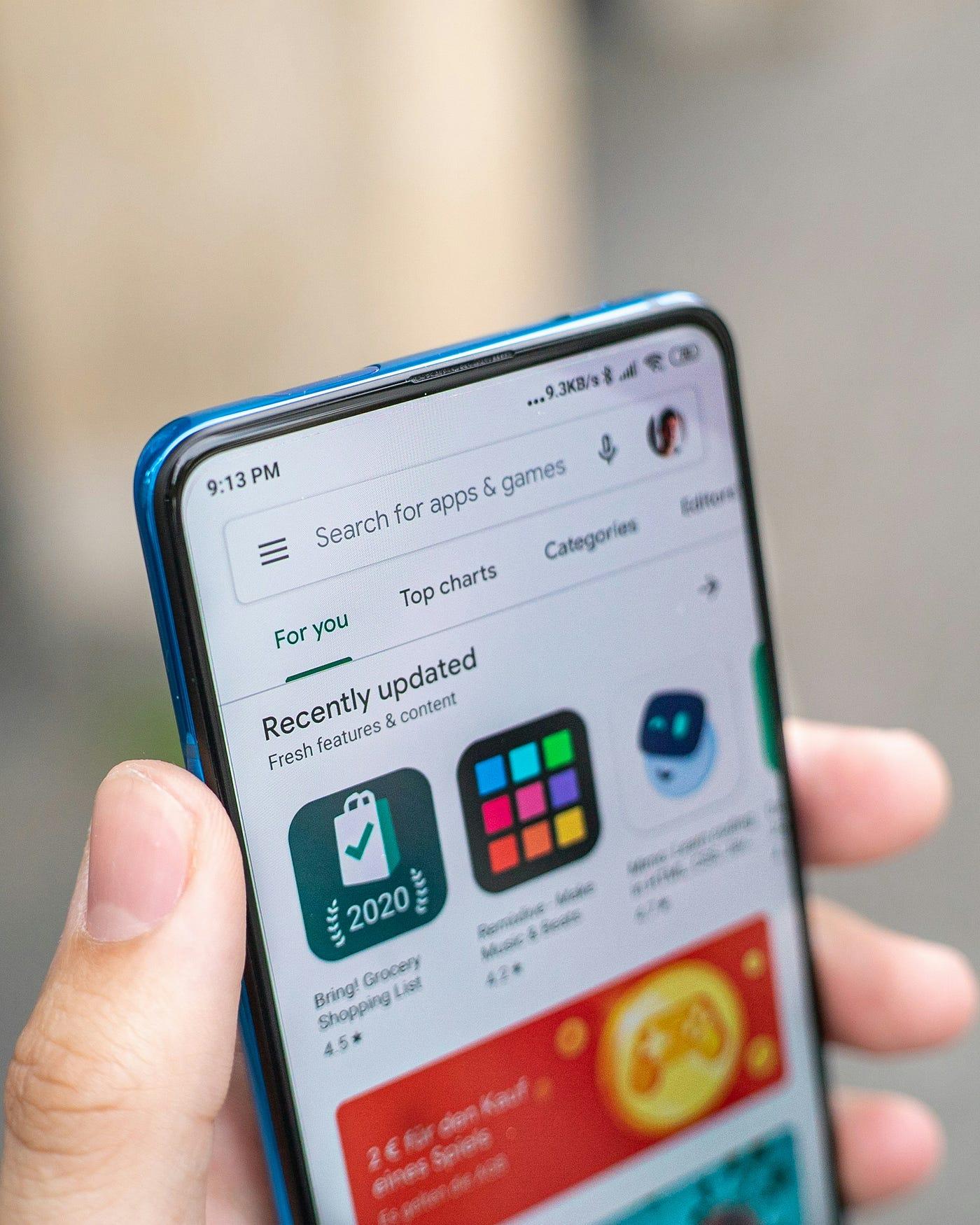
ASO pursues two goals:
- a better ranking in search and in the browse sections of the app stores
- a higher conversion rate, meaning more installs per visit to the product page
The two are linked. Apple lists text relevance (title, keywords, category) and customer behaviour, including downloads and the number and quality of ratings, as ranking factors. A product page that converts well therefore also improves its position.
ASO and SEO: what is the difference?
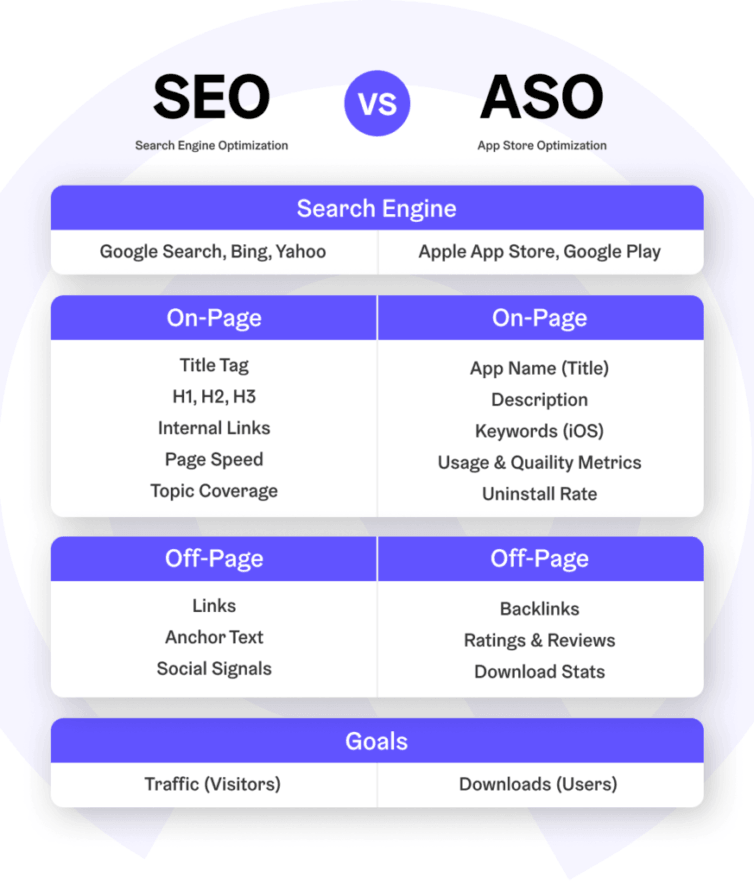
ASO is the SEO of the app stores. With SEO you optimize your website so that search engines rank it as high as possible. With ASO you optimize your store listing so that Apple and Google surface your app for the right queries and users then go on to install it.
The stores work like search engines with a shop attached: they want to suggest the app that matches the query and that users will be happy with afterwards. Competition is fierce. According to 42matters, the Apple App Store and Google Play each list around 2.5 million apps as of August 2026.
One difference from SEO: off-page factors barely matter. What counts is the metadata in your listing and how users behave.
Source: App Radar
How app store optimization works
Before you touch copy or images, you should be able to answer four questions:
- Who is the app’s target audience?
- What terms does that audience search for?
- Are the app and its audience multilingual?
- Which problem does the audience expect the app to solve?
The answers determine your keywords, your visuals and your localization.
Keyword optimization
- Research: tools such as AppTweak, Sensor Tower, AppFollow or MobileAction show search volume, competition and the keywords your competitors rank for. Add the store’s own autocomplete and your users’ support requests; that is where you find out how people actually phrase things.
- App Store: Apple indexes the app name (30 characters), the subtitle (30 characters) and the keyword field (100 characters, invisible to users). The description does not feed into Apple’s ranking. A keyword does not need to appear twice; use the space for variants.
- Google Play: the title (30 characters), the short description (80 characters) and the full description count here. Google indexes the long description, so your most important terms should appear there naturally.
An example: for a fitness app, “workout”, “training plan”, “step counter” and “calories” could be relevant. Check for each term whether it matches what the app really does. Disappointed users uninstall quickly, and that hurts your ranking (more on this below).
The description
Answer in the first lines what the app does and who it is for, because only that part is visible without tapping “more”. Then list the main features, ideally as bullet points, and finish with a clear call to action such as “Download now and start your first training week”. The promise in the description has to match the app, because both stores measure whether users stick around after installing.
Icon, screenshots and preview video
While browsing the store, users decide within seconds whether to look at an app more closely. The icon and the first two or three screenshots carry that decision.
- Icon: recognizable even at small sizes, without fine print or cluttered motifs.
- Screenshots: show the core features with short captions that name the benefit. The first screenshots should stand on their own, because many users never swipe further. Screenshots may be designed, but they must show the actual app.
- Preview video: optional, useful for apps that need explaining. Show the app in action.
Since mid-2025 several ASO vendors have reported that Apple indexes the text on screenshots and that apps rank for terms mentioned there. Apple has not confirmed this, and other tests found no broad effect. Treat it as an industry observation: good captions on screenshots never hurt, but they are no substitute for the keyword field.
Ratings and feedback
Ratings are social proof and a ranking signal at the same time; Apple explicitly names the number and quality of ratings as a search factor.
- Ask for ratings actively: both platforms offer an in-app dialog for this. Ask at the right moment, for example after a successfully completed task, not on first launch.
- Reply to reviews: especially negative ones. Replies are public and show future users that someone stands behind the app. After a fix, users often update their rating.
- Fresh ratings: several ASO vendors observe that recent ratings carry more weight than old ones. This is not officially confirmed, but Apple displays the rating of the current version prominently, so a steady stream of new ratings makes sense either way.
Localization
If your app is relevant in several countries, translate not just the description but also keywords and screenshots. People search in their own language and with their own terms; a literally translated keyword often misses the query. Google Play can now pre-fill translations with Gemini in the Play Console (see below). A review by native speakers is still necessary.
- Example: an app for Germany and France needs two complete store listings, including localized screenshots.
Tracking and analytics
App Store Connect Analytics and the Play Console statistics show where visitors come from (search, browse, referrals) and how many of them install; ASO tools add keyword rankings and competitor comparisons. Above all, measure the conversion rate per traffic source and check after every change to icon, screenshots or copy whether it moved. Apple offers Product Page Optimization with A/B tests for this, Google Play offers store listing experiments.
User behaviour as a ranking factor
Both stores evaluate what happens after the install. Google’s developer documentation states that it uses uninstalls (user loss rate) as well as daily and monthly active users, among other signals, to assess an app’s quality, and that these metrics decide eligibility for certain placements in the Play Store. As benchmarks Google names a user loss rate below 5% and a DAU to MAU ratio above 8%. ASO therefore does not end at the store listing: an app that crashes or is never opened again after the first launch loses visibility no matter how good its keywords are.
What changed in 2025 and 2026
Apple App Store
App Store Tags. At WWDC 2025 Apple introduced tags: short terms that describe an app’s features, for example “Sleep” or “Offline”. According to Apple they are based on the metadata in App Store Connect, artificial intelligence and human curation. Tags appear in search results, on the search landing page and on the product page; tapping one shows a collection of similar apps. You can deselect tags in App Store Connect but cannot add any; Apple notes that deselecting all tags may affect your discoverability. Tags are currently displayed only in the US store and generated only from en_US metadata. The English version of your listing therefore deserves care even if your main market is Germany.
Custom product pages in search. Custom product pages (CPPs) used to be alternative product pages for campaigns. Apple now allows up to 70 additional versions per app, and you can assign keywords to each CPP. The CPP then appears in search results for those keywords instead of the default product page. Someone searching for “step counter” sees step counter screenshots; someone searching for “training plan” sees the training plan. Each keyword combination may be assigned to only one page.
Google Play
Guided Search and AI-organized results. Since autumn 2025 Google Play breaks broad queries into sub-topics and shows a small selection of apps for each. Users can type their goal (“find a home”) instead of keywords alone, and Google sorts the results into categories. A single top ranking for a generic term is worth less than it used to be, because the classic result list now sits further down. What matters more is that your listing covers a topic in its breadth and that Google can classify it clearly.
Ask Play. At Google I/O 2026 Google presented a Gemini-based conversational search in the Play Store that understands context and follow-up questions. According to AppTweak, Ask Play draws on the developer’s website as well as the store description. Contradictions between listing and website therefore weigh more heavily.
Gemini in the Play Console. Google uses Gemini to pre-populate store listings in other languages and to generate a tailored custom store listing from a keyword recommendation automatically. Responsibility for tone and factual accuracy stays with you.
Rollout caveat. According to industry reports, many of these AI features are initially limited to English-speaking users outside the EEA. For European markets it is worth keeping an eye on the Play Console release notes.
ASO and AI search
More and more users ask ChatGPT, Gemini or Perplexity for a suitable app before they open the store. At I/O 2026 Google also announced that the Gemini app can recommend and install apps directly. ASO remains the foundation for this: AI assistants rely on store listings, ratings and your app’s website. What is missing or contradictory there cannot be invented by a language model. What else you can do to make your app show up in AI answers is covered in our article From SEO and ASO to GEO.
ASO tools at a glance
- AppTweak, Sensor Tower, AppFollow, MobileAction: keyword research, rank tracking, competitor analysis, review management. Sensor Tower acquired data.ai (formerly App Annie) in 2024; the App Annie brand no longer exists.
- App Store Connect and Google Play Console: traffic sources, conversion, A/B tests, tags (Apple), Gemini translations and custom store listings (Google). For most apps the most important data source.
- Apple Ads and Google Ads: search ads are not ASO, but they quickly deliver data on which keywords actually convert.
Conclusion
ASO is an ongoing task. The fundamentals from 2024 still apply: matching keywords, screenshots that show the benefit, well-tended ratings and clean localization. Added to that are Apple’s tags and the keyword mapping for custom product pages, Google’s Guided Search and the Gemini tools in the Play Console. All of these derive what your app stands for from your metadata. The clearer and more consistent your listing is, in every language and on your website too, the better store algorithms and AI assistants can work with it. Schedule fixed dates to review rankings, conversion and ratings and to update the listing.
Frequently asked questions
Does the App Store description count for ranking?
As far as is known, Apple indexes the name, subtitle, keyword field and category, not the description. On Google Play the description is part of the index. Write the description for users regardless; it decides the conversion.
Does a German app need English metadata?
Yes. Apple currently generates tags exclusively from en_US metadata, and many users in Germany run their devices in English. A carefully maintained English listing is therefore worthwhile for the German market as well.
Will AI search replace classic store search?
No. Store search remains the largest source of downloads, and AI assistants draw on the same data you maintain for ASO. Keep your store listing, ratings and website consistent and you benefit from both.
Sources
- Apple Ads: App Store Ad Placements (“Almost 65% of downloads happen directly after a search”)
- Apple Developer: Discoverability on the App Store
- Apple App Store Connect Help: Manage app tags
- Apple Developer: Custom Product Pages
- TechCrunch: At WWDC, Apple says it will use AI to tag apps (June 2025)
- Android Developers Blog: I/O 2026, What’s new in Google Play (May 2026)
- Google Play: The Latest from Google Play, Q3 2025 (Guided Search)
- Android Developers: User metrics on Google Play (App quality)
- AppTweak: Google I/O 2026, what the Gemini era means for Google Play ASO (June 2026)
- Phiture: ASO Trends in 2026
- AppFollow: ASO Ranking Factors, The Complete Guide for 2026
- 42matters: Google Play vs iOS App Store Stats (as of August 2026)
- Sensor Tower: Sensor Tower acquires data.ai (March 2024)